Todor Blajev
 ES
ES
Triodos Bank: A Good Start, A Bad End
The beginning
I opened my personal account at Triodos Bank in the summer of 2012, almost seven years ago. Back then, it was a small bank, too new for the conservative minds who preferred to use more renowned banks that had been in the market for much longer.
The problem I saw back then with those banks and the banking system in general was the lack of transparency. I wanted more information about how they generated their income and what they did with my money. This was the proposal that initially drew me to Triodos' offer.
In addition to transparency, there was the value of sustainability. From small details like making bank cards recyclable to having almost all operations online, avoiding the need to generate tons of paper and waste in physical branches.
As part of their commitment to transparency, I was surprised to see such a small bank charging hardly any fees, with no requirements for direct deposits or the purchase of shares like other institutions demanded.
The issue of bank fees has always seemed very symbolic to me representative of the current state of banking. It’s their way of saying: we’re charging you for this service because we don’t need your money. The agreements they have with the European Central Bank and with governments allow them to be completely independent from individuals in the way they generate income. Clients, whether individuals or businesses, are a minor inconvenience a service they have to provide in order to obtain a banking license and maintain a front-facing business that justifies their existence in the eyes of the public.
The next time you find yourself in a bank and feel that you're not being served, valued, or respected as a client, remember this: banks don’t need to provide you with good service in order to exist and make millions.
Going back to Triodos, I felt their philosophy was different because they had such low fees. They were even transparent about the expenses I incurred with my VISA card abroad, charging me only a 1% fee per card payment, which is the fee VISA charges them. Other banks, like Caixa Bank, have charged me up to 5%. Moreover, it’s a hidden fee since they include it in the currency exchange rate, and you don’t even realize you’re paying it.
For several years, I had my personal accounts and the accounts of three companies at Triodos. We had some hiccups in operations when they changed their IT systems, but they were always very responsive and did their best not to interrupt our business activities despite the technical department’s issues.
Another positive point I must mention is the Triodos Bank Awards for sustainable companies, where every year I come across financed companies carrying out very innovative and valuable projects for society in terms of development, environment, and sustainability.
The end
Just over a month ago, I made the decision to close all my accounts at Triodos Bank. It happened suddenly after an incident caused by the bank that I couldn’t let go.
I was traveling, at an airport, and when I tried to withdraw money from my personal account, the ATM informed me that my account was blocked. I logged into online banking, and both my personal and business accounts were inactive. They had been blocked without prior notice.
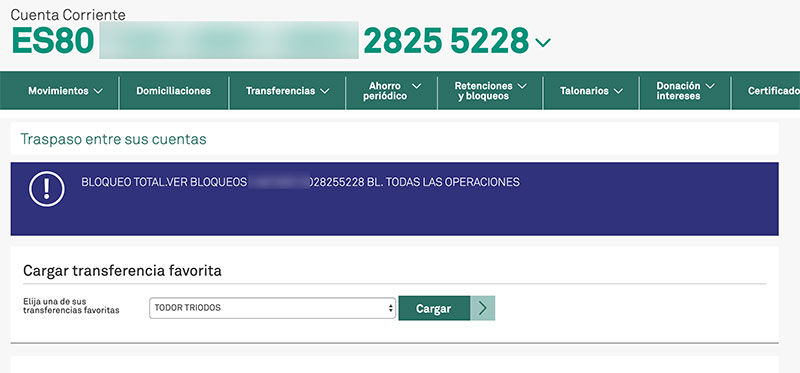
In the middle of my trip, I contacted their support department.
The woman who assisted me kindly explained that some time ago they had requested documentation related to the Anti-Money Laundering Regulations for one of my companies. This is the content of that email:
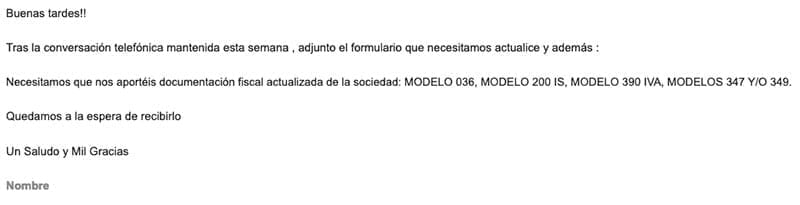
My response at the time to this email was to ask Triodos Bank, as a private entity, what right they had to request all this financial information that I already submit to the Tax Authorities through secure data platforms. I also pointed out that they were asking for informational declarations containing personal data of professionals and freelancers who are my clients, so if I were to provide them with this information, it would have to be through a secure channel as mandated by the new Data Protection Law.
In response to my email, they simply copied a lengthy legal text regarding the Anti-Money Laundering Regulations and assured me that they would handle my data confidentially, once again requesting that I send the documents by email (an UNSECURE method).
Here is just one paragraph from the reply email they sent me, to give an idea of what is happening:
We inform you that Triodos Bank, as a credit institution, is obliged to comply with the current regulations on money laundering (Law 10/2010, of April 28, on the prevention of money laundering and terrorist financing and its implementing regulations), which includes having information about the origin of funds and the transactions carried out by its clients.
Note that the text does not specify exactly what data the client is required to provide, nor how it should be submitted, leaving it to the discretion and interpretation of the legal department of the banking institutions.
In this context, entities like Triodos Bank appear, whose legal department decides to request all the sensitive information I described above, while neither providing a secure way to receive it nor informing about the procedure to rectify or delete that personal data as required by law.
Other institutions, like ING Direct, interpreted this regulation in a simpler way, limiting the procedure to a questionnaire that we can complete online.
Another detail you may have noticed in the text they sent me is the appearance of phrases like “money laundering and terrorist financing” in an email addressed to a client. Basically, using fear as a wildcard, they have carte blanche to monitor all your economic activities and client data. I don’t agree with this I already provide my taxes and data to the Spanish government through the designated channels.
Going back to the day my accounts were blocked, what I’ve just explained believe it or not was the reason Triodos Bank used to block not only the business accounts of the company for which they were irregularly requesting all this documentation, but also my personal accounts, without any justification or basis.
After my phone call, they agreed to unblock my personal accounts as well as my company’s accounts for a few days, while continuing to request the same documents and without complying with the requirements of the Personal Data Protection Law.
After a week, they blocked my company’s accounts again, but by then I had already moved almost all my operations to banks that operate in a way much more aware of the customer’s needs.
In summary:
Triodos Bank started in Spain with good intentions and good service
They support many social and sustainable development projects that positively contribute to society
They have few and low fees
They keep their promise of transparency by publishing how they generate their income and what they do with your money
Unfortunately:
The bank, like many others in recent years, is run by its legal department
The legal department operates out of fear, not out of a desire to satisfy its customers
They request sensitive data from companies, including income statements, informational declarations, client data, and contracts
They do not comply with the Personal Data Protection Law in their requests
They block your accounts and operations without prior notice if you don’t send the data by email (an insecure channel)
You can see the alternatives I’ve found to Triodos Bank, as well as to traditional banking which shares many of Triodos’ drawbacks, including lack of transparency and high fees in this article:
3 Banks You’ll Want to Work With in the 21st Century
Have you had any positive or negative experiences with a Spanish bank lately? Share your thoughts below.
Todor Blajev Copyright © 2025. All rights reserved.